Why Great Leaders Never Settle for Standard
After Martha returned from prison, we were rebuilding the business and advertiser confidence, trying to convince the market and disbelievers that our best days were ahead of us.
We wanted to make a splash at one of the industry's biggest conferences. Where the entire market was hoping to capture attention, generate meetings, and win new business. The pens, tote bags, and giveaways of the day were all a part of it.
The pressure to perform often results in everyone looking the same. That pressure leads to protection.
Protection says:
"Let's get a bigger booth."
"Let's make the sign brighter."
"Let's spend more money."
When the stakes are high, following the tried-and-true playbook feels safer than creating.
Innovative leaders don't ask, "How do we work harder to compete?"
They ask, "How do we compete differently?"
Working at the brand of Martha meant average was unacceptable. Exceptional is expected. So our brilliant head of marketing at the time asked a different question.
What is an experience we could create that people would remember?
And then the idea: How about a Martha Stewart vending machine?
Not a vending machine filled with candy. A Martha Stewart product vending machine. I wish I had a picture! Conference-goers received a custom coin after exchanging business cards. They'd drop it into the machine, push a button, and one of many potential products would emerge from the delivery window.
One of Martha's books.
A beautiful kitchen towel from her collection.
A spatula.
Or, a warm apple pie.
It wasn't actually a vending machine. There was someone standing behind it delivering every surprise. Warming the apple pie in a microwave.
We couldn't believe it when a line formed. People weren't just waiting for their turn. They were standing around watching everyone else's turn.
"Did she get the apple pie?"
"What came out that time?"
"Go over there - you have to see this."
We didn't just create a giveaway. We created an experience people wanted to be a part of. We gave people something unexpected and something worth talking about.
The vending machine wasn't 'innovative,' but I believe the thinking behind it was.
Pressure closes our imagination. It protects us from thinking powerfully.
Pressure doesn't just limit our creativity - it also narrows what we're able to see as leaders. When we're operating under pressure, we often miss opportunities hiding in plain sight because our thinking becomes reactive instead of intentional.
Protection says 'do what’s already been done' or 'do what everybody is doing in the moment'.
Innovation says: Create something people can't stop talking about.
Every one of us has their own version of the conference booth.
Maybe it's your customer experience.
Maybe it's your onboarding.
Maybe it's your sales process.
Maybe it's the way your leadership team meets.
Maybe it's the way your people solve problems.
This week, ask yourself:
Where have you started doing what's expected instead of what's exceptional?
Where have your standards quietly become ordinary?
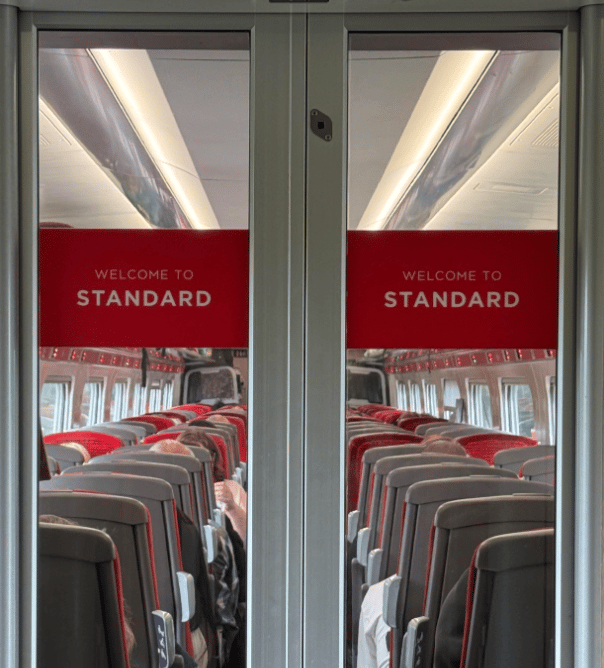
This was on the train in London to differentiate the main cabins from first class. It struck me: 'Welcome to Standard'. Is standard ever ok?
This was on the train in London to differentiate the main cabins from first class. It struck me: 'Welcome to Standard'. Is standard ever ok?
Average doesn't happen overnight. It happens one compromise at a time.
One...
"That's probably good enough."
One...
"That's how it's done.”
One...
"We don't have time."
Until we stop looking for exceptional because no one expects it anymore.
Organizations that create extraordinary growth aren’t the ones with the biggest budgets. They are the ones with the leaders courageous enough to create time to think, explore, and ask better questions.
As leaders, our standards become our culture. Your culture determines whether people protect what's been done or imagine what could be done.
Resist letting pressure push you toward what's expected. Create something worth remembering.
This is exactly what I help leadership teams do today - not generate more ideas, but ask better questions that make new possibilities visible. I give you time to think, a framework to see more clearly, a system to break The Protection Loop, and a plan to drive growth.