There’s Almost Always Another Way In
There are moments in your life that change you. Vomiting up a Hostess Twinkie I’d eaten for breakfast on my first day as a U.S. Open ball girl was one of them.
I was 13 years old. That morning, I made my way into New York and out to Flushing Meadows by myself. I was nervous and beyond excited. I was going to work at the U.S. Open.
Then came the heat. The nerves, the sun, the humidity. I got sick on the court in the middle of a professional tennis match.
The medics carried me to first aid and put me in an ice bath. I had heat stroke.
When they released me, I went to my boss to apologize. I felt humiliated. I was told to get back to work and head out to another match.
Two days later, my throwing arm got me fired. Part of the job was throwing the ball from one baseline to the other. My weak 13-year-old arm couldn’t get it there.
I was devastated. I loved being part of The Open and knew I wanted to come back the next year.
I figured out another way in. For the next two years, I returned to Flushing Meadows to manually update the tournament scoreboard as fans entered the complex. [No computer scoreboard back then.]
I found another way back.
Billie Jean King famously said, “Pressure is a privilege.” Those words are on a plaque the players pass as they walk onto center court at the U.S. Open.
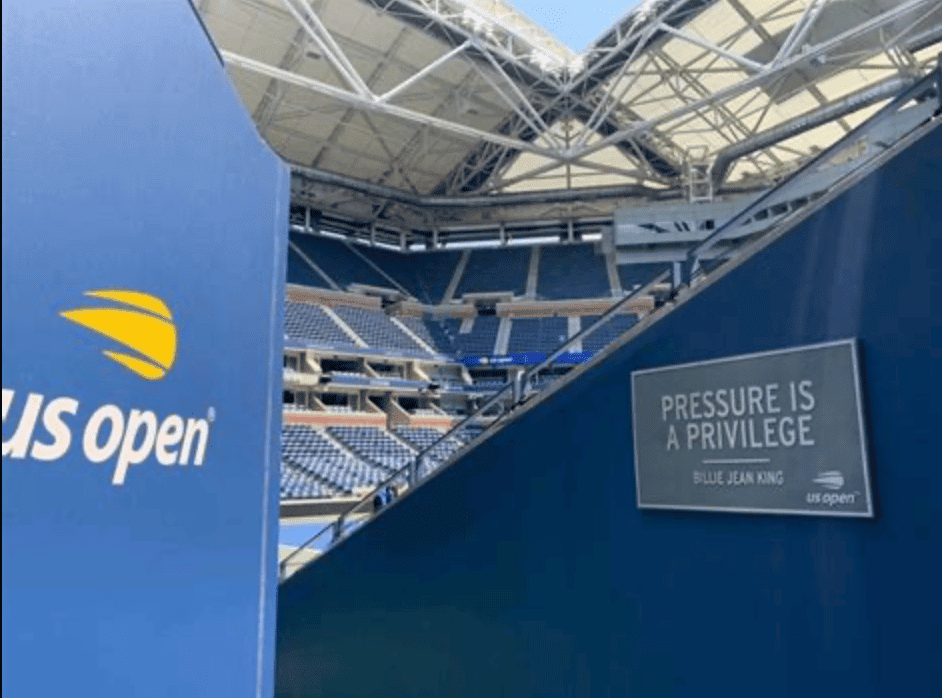
Pressure is today’s leadership condition. It carries both weight and opportunity.
Pressure doesn't just happen to you. Sometimes it’s there because you’re doing something that matters.
What if the pressure isn’t proof that something is wrong?
What if it’s proof that something matters?
Ask yourself this week what truly matters to you. Then expect to lose some of the points you are going for.
Roger Federer won 54% of the points he played over his career. He lost 46% of the points he played.
One of the greatest tennis players of all time lost almost as many points as he won.
Only four percentage points more than half separated winning more points from losing more. That just blows my mind.
That’s a lot of missed shots. A lot of lost points. A lot of moments when things didn’t go his way. Roger didn’t let the missed shots determine his future. He didn’t stay in blame or shame. He didn’t stay stuck in what wasn’t working.
He dug in and focused on the next point.
Winning isn’t about avoiding the misses. There will always be misses. Imagine if 46% or nearly half of them are misses.
What would you change this week if you knew nearly half of your effort would miss, but that you’d still come out winning?
Take more shots.